Wednesday, April 17, 2013

Jorge Marin - The Body as a Landscape


With over 25 years of artistic work, he has successfully entered into Mexico's artistic scene and has become a representative of figurative international sculpture.


Marin’s remarkable career has included over 150 exhibitions in Latin America, North America and Europe.


The sculptures of Jorge Marin reflect in bronze the intrinsic strength and force that emanates from its creation and permits him to construct dynamic bodies, full of movement, which challenge gravity and rotate in space supported on one point.


 There is a constant subject in Jorge Marin’s sculpture, which is the body as an entity containing the spirit, always appearing in the splendor of its physical state. The being is always explained by what contains it, the body.


Today, the body is conceived more as a space than an object in and of itself. It is the scenario of the human struggle as well as its synthesis and its memory. Thus, the human figure narrates humanity’s own becoming, and the body is, after all, simply landscape.


His work also represents the struggle between the coldness of bronze and the diverse emotions that his subject's evocate: the perfect balance of the equilibrists and his winged figures has become his particular seal. While it is true that his series of bodies tends to be based on the triumph of their acrobatic postures, metaphorically these bodies are speaking and surrendering to the temptation of risk and the prophecy of failing and falling down from this dubious paradise in which we live.


Another notable trait in his work is the mask, an attempt to depersonalize his sculptures and become another medium of expression of a body that contains universal symbols in itself.


“My artistic proposition follows my vision and perception of the world, how I interpret it and how I see it. From there, I dealt diverse topics, always related to the people of the 20th and 21st century, that is to say contemporary. It is also possible to say that they are questions of the man of all the times – as the paternity, the game, the balance, the fear, the love, the hatred, etc.”


He currently exhibits "Wings of a City" in Mexico City, which opened in 2010, and another of his exhibits, "The Body as a Landscape", has been shown in museums and galleries throughout Europe since 2011, including Paris, Madrid, Lisbon, Istanbul, Berlin, Brussels Budapest, Timisoara, and will be shown in St Petersburg and Brussels .  His work is currently on permanent exhibition at R E Welch Gallery in Seattle.

R E Welch Fine Art Gallery

Monday, April 1, 2013

Philippe Dutilleul - Poet of Light


That delicate touch of light!
Each painting that Dutilleul undertakes is a new quest. His desire to paint, and always to renew, goes hand-in-hand with the subtle investigation into light and shade.


In the midst of a very successful career with prestigious representation in one of the best galleries in Paris, Dutilleul’s health faltered. He suffered from an illness that robbed him of his sight. For nearly fifteen years he was subjected to fevers and deadly headaches. Fortunately he recovered a few years ago and started painting again. He now feels the illness brought him to where he is today. There is no regret. There is an enhanced love of life. Light is an obsession.
It is these glimpsed effects that he will search for and collect in the area around Uzes, the Cevennes, the Lozere and further afield in Corsica and Andalucia. "Lighting interests me perhaps even more than landscape" he reveals.


His passion is such that, whilst painting, he is already imagining the quest for and discovery of new colors for his next works. Every day he feels both his vision and skill developing. Technically he begins with a luminous, lightweight coat of acrylic paint, next enriching the canvas with delicate strokes of oil paint. This results in an ethereal, heavenlymountain landscapes, using royal blue, violet, at the same time introducing in the shadows – some secret hints of red ochre. The gorge thus illuminated, becomes suddenly sensuous . . .


Originally from the misty north, Dutilleul attended the Decorative Arts School in Toumai, and then the Acadamy of Fine Arts in Douai.  Inspired by paintings of an earlier age, he practiced the delicate craft of restoring paintings for the Museums of Strasbourg.  Hooked on art history, he became intimately acquainted with the Old Masters.  This interest has never left him, for even today, to relax, he makes accomplished copies of an Arcimboldo, a Rembrant or a Vermeer.  His relationship with the latter is very special, in fact it is not unusual for him to follow the Dutchman’s example of using almost photographic soft-focus in the foreground combined with strong keylight.  A colorist, he treasures memories of some key works:  Monet, Matisse, Bonnard or even Bioules.


At the moment of achieving superlative beauty – a perfect footprint in the clay – he makes a sky shine with fire beyond a jagged horizon, giving us moments of pure unforgettable poetry.  From one canvas to the next, Dutilleul makes the great spectacle come alive for us, with a background accompaniment of subtle, sublime music.

Thursday, November 1, 2012

Herve Dubreil - Unusual Perception


Dubreil’s work was recently exhibited at the Vasarely Foundation in Aix-en-Provence in connection with a Picasso retrospective.


We see hesitant figures moving in imaginary spaces, mixing with each other and connecting in a fluid space. Neither abstract or figurative, Dubreil’s work is a world in motion, frozen in colors and texture. Dubreil has matured and modified his pictoral expression over the years and has recently brought into his studio the inspiration of his love of Jazz. A universal harmony emerges from his work. These are works of distinction which never impose on the viewer or even the subject.


He is an artist who makes no concession


No tricks are allowed


Art at its purest

Monday, October 1, 2012

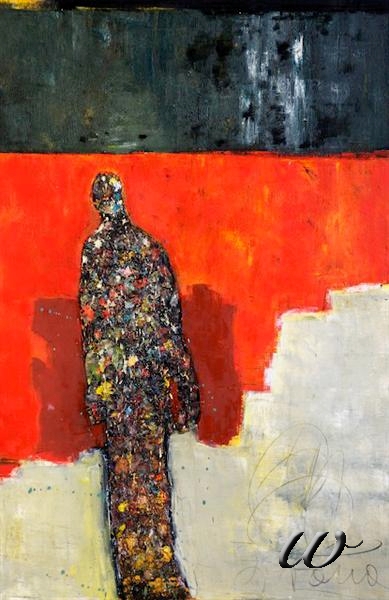
Zivana Gojanovic - Existentialism


The very nature of existence, of experiencing our own existence, is primal.
It goes beyond thought or words.
The recurring theme to Gojanovic’s work is
existentialism, the struggle of the common
man to overcome, or just to understand,
the forces that are larger than himself that
shape his existence.
 

Man is a vessel that
carries his soul if released to the sky the
two become whole. ENERGY. We all walk
a path of many tales and in the end the story
will be told. A window is not to only open
and close, it is to see the beauty around.
Her work is not subject to cultural trends
or current events.


Her themes are
timeless. The very nature of existence, of
experiencing our own existence, is
primal. It goes beyond thought or words.
Her paintings emerge from the
subconscious mind, a place where words
do not exist in and of themselves.


The subconscious constantly keeps its own
record of experience. It is the fertile
ground that germinates our ideas of who
we are and where we are going. This is
where she resides when she paints:
beyond words or trends. The
subconscious is a mystical place, and
its primal propulsion drives us all.

So in her paintings, through repetitive
symbols, strong colors and shapes she
attempts to create an emotional state in
the viewer that allows him to connect to
his own core strengths, transcending the
Sisyphean tasks of daily life and thereby
reaching a state of hope and enlightenment.
Her work has been exhibited in the
United States and Croatia and is in the
private collections of David Copperfield,
Magician/Entertainer and Dr. Laura
Schlessinger, Radio Personality. In 2007
she was commissioned to paint Senator
Hillary Clinton’s portrait.

Saturday, September 1, 2012

Alina Maksimenko - Wandering Palette

Her paints resemble sounds


"My fingers wander around the canvas as I play with my instrument.My eyes will dash through the darkness of paint like headlights in the night."

This is how Maksimenko describes how she works.

"My ears hovering over the world,
like a bat spreading its wings to fly.
First I know not where I am,
I see nothing in front of me,
I hear not a word.

But the beating heart of my fingers,
eyes & ears come together
and tell me about it all,
everything."

 Maksimenko is spontaneous by nature
and consequently having an open, natural
and uninhibited manner enables her to work
both independently and with an obvioius
sense of freedom.

Her confident lines are always loose and fluid;
showing the observer her true quality and strength,
which lies in her simplicity.
Whether one is admiring a harbour scene,
a still life or a nude,
one is immediately struck by her excellent composition
and her extraordinary use of color.
 
Her paints resemble sounds.
Artfully colorful, the crawl out of their shelters -
jars, boxes, small and large tubes -
and scream in different voices when trying to
assume possession of the biggest possible territory.
 Many people are inspired by Maksimenko's work
and a great many of these people are artists themselves.
That surely speaks volumes about Maksimenko who is
undoubtebly a shining star from the East.
Her work has been exhibited all over Europe
in France, Ireland and the United Kingdom as well as
Croatia, Russia and Ukraine. 

Wednesday, August 1, 2012

Dany Jung - Playfulness


Dany Jung - Playfulness


In 1962, Jung discovered traditional Alsatian pottery in Soufflenheim. His skill has evolved and he has clearly been influenced by his travels abroad. His recent work is inspired by the ancient art of Chinese burial figures. He has added a dose of his whimsical personality to each piece.


Between heaven and earth, between the fall and flight, he cultivates a taste of the imbalance in a harmonious sculpture. As a graphic designer, he loved the line and shapes. Traveler first, bringing back wonderful books, a fortune of information about the countries he visited.


It is an art to escape gravity. To Dany Jung playing and creating defies the world. Sophisticated is the circle, acrobats and dancers, animal exhibitors, wrestlers. It is a circle of movement, a circle of excellence.


Tuesday, May 1, 2012

Jean Triolet - Painter of Felicity

From the fragrance of the garrigue, one drifts slowly towards
that impalpable lightness of things that attests that his
paintings are about felicity.

A grey-blue background, a hand and brush that paint. A line is drawn, forms appear. In several minutes, a landscape of Provence emerges on the canvas. And the painting had the effect of an antidote. If you are depressed or melancholy, settle yourself in front of this armful of colors. Your eyes light up, a smile comes to your lips, your soul finds serenity.

Painting is to Triolet what rhetoric is to a public defender: an arsenal for eloquent expression. Between the Mediterranean and the Alpilles, he found the land whose beauty he has recreated for thirty years, the Provence “that laughs, that cries, that sings with the cicadas.”

“I’ve always had Cezanne’s palette, I mean in the tones,” he explains. “For three decades, I’ve played with the nuances. There is a law in painting: one color is judged in regards to another color.”


Each canvas of Triolet is a personal vision of Provence, a Provence of origins, quasi-immemorial, that he would like to see preserved from the ravages of industrialization and galloping urban growth. Nostalgia? No.  Only the love of nature and respect for an indentity. One cannot help but subscribe to this thought of Alauzen di Genova: “The painter in front of his stretched canvas reconstitutes the mental architecture that he transposes from nature - to render it more sensible to others.” Who would blame Triolet for magnifying or idealizing his Provence?

The still-lifes and landscapes confirm his gifts of observation and his infatuations. What has changed, someone has said, are the softest colors. This is a new departure in his painting, yet not a repudiation of his previous criteria. And nothing allows us to judge this better than his recent productions or exhibitions. His art has the same coherence.

Triolet has too much experience to ignore that painting is a profession, a double engagement of the eye and spirit. It is an art of perception as much as one of memory. If the French artist, ambassador for his country, is appreciated in Europe and overseas, it is because in the United States, in Japan, in Switzerland or in Canada, people like knowing that his painting is more about what it contains than what it shows.

His paintbrush reconciles you with the real treasures of life. He is a painter of felicity.